Author: Chatgpt
Image Credits: Gemini
In every age, human beings have wrestled with the same riddle: what should we do with our power?
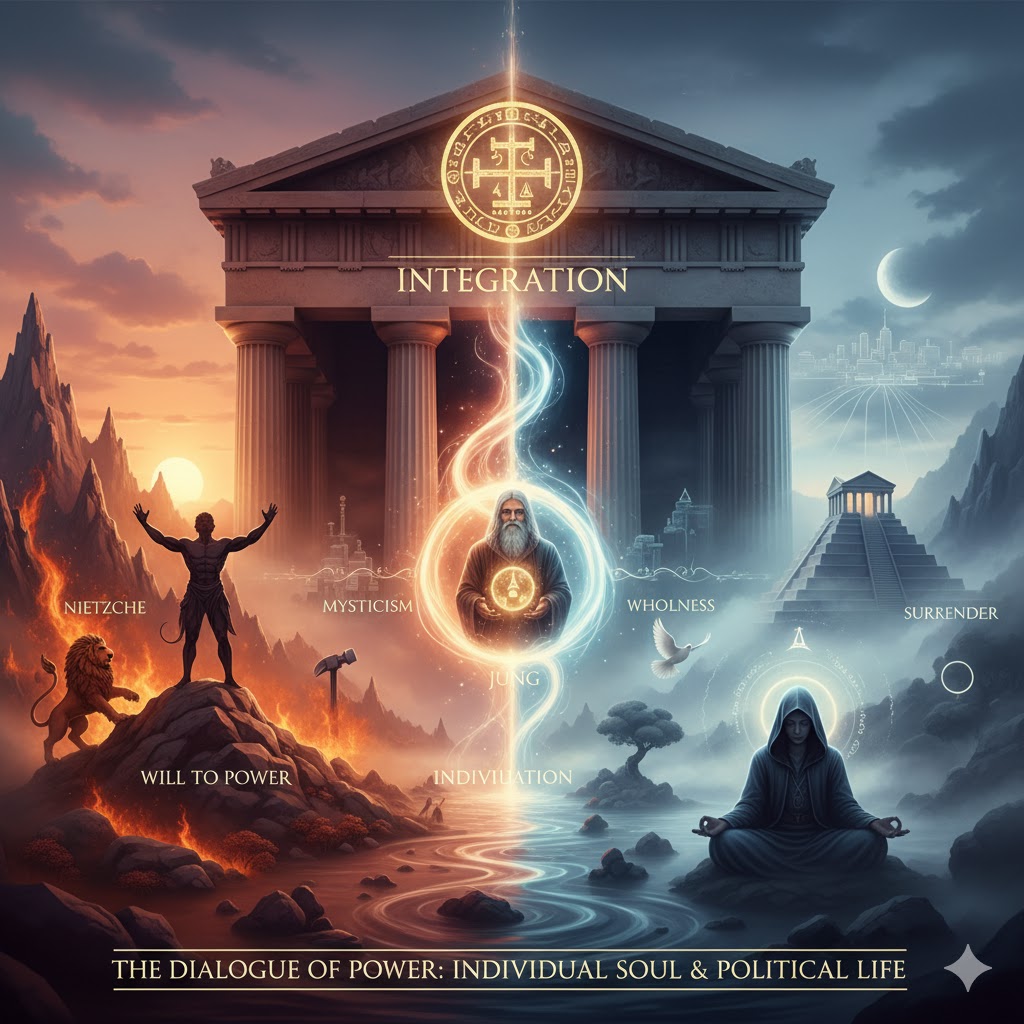
Should we exalt it, surrender it, or integrate it into something greater? Nietzsche, the mystics, Jung, and Plato each answered this in their own way — and their dialogue, when drawn together, offers both a map of the individual soul and a blueprint for political life.
I. The Individual Drama
Nietzsche: Exalting the Will
For Nietzsche, life’s essence is the Will to Power — the impulse not just to survive but to expand, create, and overcome. To deny it is to deny life itself. On the individual level, Nietzsche calls for self-affirmation: to become Übermensch, a creator of new values in a disenchanted world. Power, in this sense, is not brute domination but vitality, artistry, the courage to stamp meaning onto existence.
Mysticism: Killing the Will
Mystical traditions, however, turn the lens in the opposite direction. For the Sufi, Christian, Buddhist, or Vedantin, the ego’s will is the great illusion. To cling to it is to remain in bondage. The path forward is to die before you die — to dissolve the ego’s striving into the Absolute, to surrender one’s will to God or the Void. Where Nietzsche cries “become more,” the mystic whispers “become nothing.”
Jung: Integration, Not Extinction
Jung saw in both positions half of a truth. To kill the will, he argued, is to repress psychic energy, leaving it to erupt in shadow form. To glorify it without restraint, as Nietzsche risked, is to inflate the ego into madness. For Jung, the task is individuation: integrating the will into the larger Self, a psychic totality that transcends but includes the ego. The will is not annihilated but transformed — like base metal into alchemical gold. Power becomes not domination, nor surrender, but wholeness.
“Blessed are the meek, for they shall inherit the earth.” – Gospel of Matthew (5:5)
II. The Political Drama in Plato’s Republic
Plato’s Republic stages this same conflict at the level of the city.
Thrasymachus: Justice as Power
In Book I, Thrasymachus erupts with Nietzschean cynicism avant la lettre: “Justice is nothing but the advantage of the stronger.” Laws serve rulers, not citizens; morality is a mask for domination. This is the political form of the will to power: cities are organized self-interest writ large.
The Philosopher-King: Ego-Death in Politics
Plato answers not with more power but with philosophical surrender. The philosopher-king, who has ascended from the Cave to the vision of the Good, rules not for himself but for the harmony of the whole. Like the mystic, he kills his private ambition to embody a higher order. Political justice is not self-assertion but self-transcendence: each class in the city, like each part of the soul, does its proper work.
Socratic Mediation: Harmony as Integration
And yet Plato does not abolish power. The guardians still fight; the rulers still govern; the producers still strive. What makes the city just is not the extinction of will, but its integration into a balanced whole. Each part of the city, like each part of the soul, performs its function under the guidance of reason. This is Jung’s individuation on a civic scale: the city as Self, integrating its drives into harmony.
III. The Parallel
- Individual: Nietzsche’s raw will is the appetitive drive, the mystic’s ego-death is pure rational transcendence, and Jung’s individuation is the spirited balance that lets reason, courage, and desire coexist without tyranny.
- Political: Thrasymachus’ cynicism (will to power) and the philosopher-king’s mysticism (ego-death) are reconciled in Plato’s just city, where each part serves the whole.
In both cases, the answer is not suppression or exaltation, but integration.
IV. Why It Matters Now
In our time, the temptation of pure Nietzscheanism is visible in politics that glorify domination and self-assertion. The temptation of pure mysticism is retreat — a politics of withdrawal, of denying worldly responsibility in favor of private transcendence.
Plato, like Jung, shows another way: neither domination nor flight, but harmonization. The task of both the soul and the city is to integrate power and surrender into a balanced form of justice.
Conclusion
When man kills his will to power, he risks becoming nothing. When he worships it, he risks becoming a tyrant. But when he integrates it — when he turns will into wholeness — he becomes just. And when a city mirrors this, it becomes just as well.
Thus the Republic is more than a political treatise: it is a manual for individuation at scale, where Nietzsche’s fire and mysticism’s surrender meet in Jung’s vision of integration, under the light of Plato’s Form of the Good.
“…For the kingdom of God is within you.” – Gospel of Luke 17:21