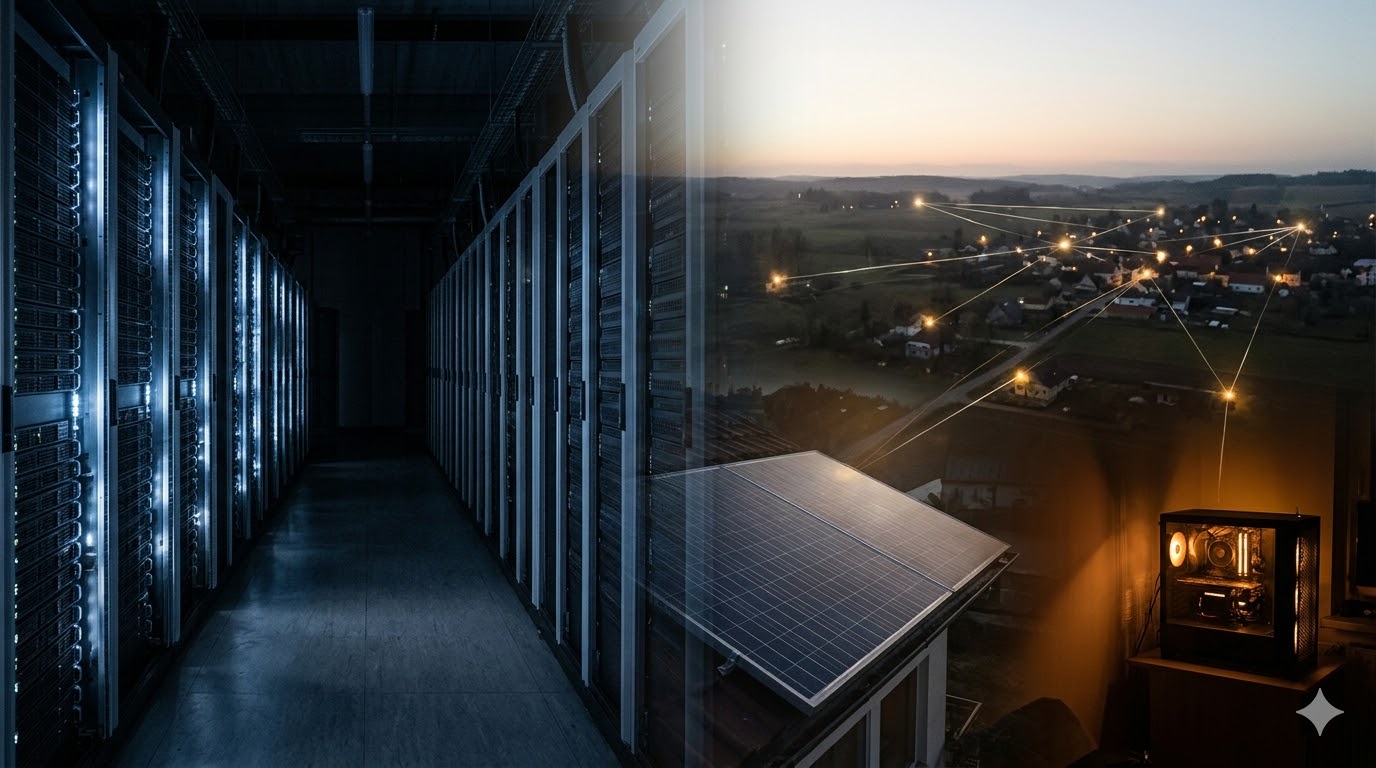
The response to centralized control has always been decentralization. The printing press against the church. Samizdat against the Soviet state. The question has never been whether the alternative exists. It has been whether it survives contact with the economic gravity of the thing it is trying to replace.
That question carries particular weight now. The tentative hope embedded in this technological moment, that AI might prove unlike every preceding technology concentration, distributing capability rather than consolidating it, returning agency, sovereignty, and control to the individuals these tools are meant to serve rather than to the institutions built to extract value from them, has not yet been extinguished. But it is under pressure from every direction. The forces accreting power upward, through threat landscapes, state expansion, and corporate infrastructure, are well documented and gaining momentum. What is less examined is whether the pieces already in motion on the other side, distributed compute, peer energy markets, federated social infrastructure, are sufficient to constitute a genuine alternative before the window closes. That is the investigation this article attempts.
But the current crisis of centralized platforms is not only a crisis of political control. It is a crisis of design. The town square was not simply captured by the state or the advertiser. It was engineered, at the architectural level, to addict. Engagement maximization is not a side effect of the advertising model. It is the advertising model, and every structural decision downstream of that imperative, the infinite scroll, the variable reward notification, the algorithmic amplification of outrage over nuance, follows with the same logic that governs a slot machine. The dopamine loop is not incidental to the platform. It is the platform’s primary product, packaged as connectivity and sold as community.
The consequence is not simply distraction. It is epistemic. A population whose attention is architecturally captured by content calibrated for emotional provocation rather than informational value does not simply become less informed. It becomes less capable of the sustained, friction-tolerant reasoning that democratic participation requires. Polarization is not a bug in this system. It is the metric the algorithm optimizes for, because division drives engagement, and engagement drives revenue, and revenue justifies the valuation, and the valuation attracts the capital that builds the next, more efficient version of the same machine.
The question the fediverse and decentralized compute raise is therefore larger than infrastructure. It is whether an alternative can be built that is not only structurally decentralized but incentive-decentralized, one whose economic logic does not inevitably reproduce the addiction architecture of the thing it is replacing. Decentralization without a different incentive structure is not an escape. It is a rerun with different branding.
This moment has a specific quality that historical inflection points often only acquire in retrospect. The simultaneous fracturing of the post-Cold War digital order, the geopolitical scramble for AI sovereignty, the collapse of trust in centralized platforms, the emergence of credible distributed alternatives, and the first serious cracks in the hyperscaler financial model have converged in a window that will not remain open indefinitely. The architecture of the next internet is being decided now, not through a single policy choice or a single technological breakthrough, but through the accumulation of infrastructure investments, regulatory frameworks, and social habits being formed in real time. What makes this moment genuinely pivotal is not the scale of the forces in play but the fact that the outcome is still contested. The centralized path has more capital. The distributed path has more logic. Which one wins will depend on decisions being made by engineers, regulators, investors, and citizens who may not yet understand that they are making them.
The Compute Question
The hyperscaler monopoly on compute has been the least visible and most consequential chokepoint in the AI era. When the cost of running large models requires access to AWS, Azure, or Google Cloud, the infrastructure of intelligence itself becomes subject to the terms of service, the geopolitical allegiances, and the pricing decisions of three American corporations. Sovereign AI, the drive by states and institutions to control their own compute infrastructure rather than rent it from a foreign platform, is the direct response to this dependency. It is also, for most governments outside the G7, an aspiration rather than a reality.
The American hyperscaler strategy is a textbook breakthrough approach: concentrate capital at a scale that forecloses competition, then monetize the resulting infrastructure monopoly. The Big Five hyperscalers are projected to spend over $600 billion on infrastructure in 2026, a 36% increase over 2025, with roughly 75% of that spend directly tied to AI infrastructure. To fund this pace, hyperscalers issued nearly $300 billion in bonds across 2025, with a record $108 billion in Q4 alone, with projections suggesting $1.5 trillion in debt issuance over the coming years. The cumulative scale is almost incomprehensible: Goldman Sachs projects total hyperscaler capex from 2025 to 2027 will reach $1.4 trillion, more than double the $477 billion spent from 2022 to 2024, with each of the four largest hyperscalers now exceeding $100 billion in annual infrastructure spending.
The returns on this commitment remain structurally elusive. AI-related services delivered an estimated $25 billion in revenue across 2025, roughly 10% of what hyperscalers spent on infrastructure that year. Only 25% of AI initiatives have delivered their expected ROI to date, and just 16% have scaled enterprise-wide. A MIT study found that 95% of generative AI pilots at companies fail to yield meaningful results, while Sequoia Capital tracked the revenue shortfall growing from $125 billion in 2024 to an estimated $500 to $600 billion gap today, with infrastructure investment outpacing demand by multiples that keep expanding. Moody’s warns that higher capital intensity and debt levels could lead to a reassessment of creditworthiness if profit growth fails to materialize, noting that it typically takes between 12 and 24 months from initial expenditure for an AI data center asset to start generating revenue. The bet is the largest in the history of private capital. The returns are not yet visible.
The pattern is not without precedent, and that is precisely what should concern the governments and middle powers now racing to build sovereign AI infrastructure on the assumption that whoever does not participate in this buildout will be left permanently behind. The dot-com bubble was not caused by a misunderstanding of the internet’s eventual importance. The internet was transformative. The error was the assumption that transformation would arrive on the timeline that capital had already priced in, and that the infrastructure built to serve that timeline would retain its value when the timeline slipped. The housing crisis followed an identical structure: a genuine underlying asset, real estate, inflated by financial instruments predicated on the assumption that the underlying value could only rise. In both cases the productive capacity was real. The misattribution was in the certainty of the schedule. A growing cohort of analysts now applies the same diagnosis to AI infrastructure spending directly, arguing that the technology’s long-term significance is not in question but that the capital committed to the current buildout has priced in a rate of adoption and monetization that the evidence does not yet support.
For sovereign AI strategists, this carries a specific warning that the geopolitical urgency of the moment tends to suppress. Capital misallocated at scale into centralized infrastructure that does not generate its projected returns does not simply evaporate. It forecloses alternatives. The dot-com collapse did not only destroy overvalued companies. It destroyed the institutional appetite for the distributed, open infrastructure experiments that might have produced a different internet architecture before the centralizing gravity of advertising-funded platforms took hold. A sovereign AI strategy built on the breakthrough model, concentrated datacenter investment predicated on hyperscaler assumptions, carries the same risk: that when the schedule slips, the alternative path, the bricolage model of distributed compute and traded energy, will have been crowded out by the capital commitments made in the certainty that the other way was the only way.
This matters beyond financial analysis because it exposes the breakthrough model’s structural vulnerability: it requires the future to arrive on schedule. And history suggests it rarely does. Garud and Karnøe’s landmark study of wind turbine development, comparing Denmark’s distributed bricolage approach against the American pursuit of dramatic, capital-intensive breakthrough, found that Danish actors pursuing modest yet steady gains through co-shaping among many distributed actors ultimately prevailed over American actors deploying far superior resources in pursuit of a leapfrog vision. The Danish wind industry did not win because it outspent its American counterpart. It won because its model generated durable learning at each incremental step rather than betting everything on a single architectural vision that had to be correct before it could generate returns.
The parallel to AI compute infrastructure is direct. The hyperscaler model treats compute as a utility to be rented from a central provider. The bricolage alternative treats it as a commodity to be traded across a distributed network of owners. This is not a minor architectural distinction. It is the difference between a system whose value concentrates at the center and one whose value distributes across every node that participates in it. In a shared compute economy, the idle GPU in a data center, the underutilized mining rig, and eventually the consumer hardware sitting dormant in a home office are all potential suppliers in a market where buyers, researchers, startups, governments, and individual developers compete for capacity on open terms rather than negotiating with a monopolist.
io.net and Akash Network offer early evidence of what this looks like in practice. io.net aggregates idle GPU capacity from data centers, crypto miners, and consumer hardware into a unified marketplace where compute is bought and sold at market rates, bypassing the hyperscaler pricing floor entirely. Akash does the same through a decentralized cloud framework built on blockchain-based permissionless infrastructure, where any provider can list capacity and any buyer can procure it without a platform intermediary setting the terms. Whether they represent a mature alternative is an open question. That they demonstrate the direction is technically viable is no longer in doubt.
But compute is only one half of the resource equation. The other is energy, and the same decentralization dynamic is already playing out there, ahead of schedule, in places the hyperscaler model never reached. Bangladesh’s Solar Home Systems program installed over six million units across rural households, bringing electricity to 30 million people, and startups building on this infrastructure have pioneered what researchers now call “swarm electrification,” peer-to-peer networks that allow solar homeowners to sell surplus electrical power directly to neighboring households and businesses via mobile phone. The leading example is SOLshare, whose SOLbazaar platform allows households and small businesses to trade electricity with their neighbors, interconnecting existing solar home systems into a network so they can sell what they do not need and buy additional electricity when they need more, with those who lack solar panels entirely able to plug into the network at a fraction of the cost of purchasing their own system. Bangladesh is now home to the world’s first ICT-enabled peer-to-peer electricity trading network for rural households, built not through centralized infrastructure investment but through the recombination of already-deployed solar assets into a distributed marketplace.
The structural logic is identical to what io.net and Akash are attempting with compute. Surplus capacity, whether photons or processing cycles, that would otherwise be wasted becomes tradeable inventory in a peer market. The seller earns from an asset they already own. The buyer accesses a resource they could not otherwise afford. The network grows organically as more nodes join, without requiring any central provider to expand capacity. SOLshare’s model is one of helping people live by using what is already there and harnessing existing and underutilised resources, which is a precise description of the bricolage methodology applied to physical infrastructure.
The democratization of compute is not inherently constructive. The same dynamic that makes a household GPU a potential node in a distributed infrastructure also lowered the barrier for the kind of AI-augmented attacks that now compromise enterprise networks at industrial scale. The bricolage model does not sidestep this tension. It offers a structural answer to it. A distributed network whose nodes are governed by community accountability rather than central authority has a capability that centralized infrastructure lacks: the ability to identify, flag, and collectively exclude malicious actors at the network layer itself. When participation in a distributed compute or energy marketplace requires reputation, when bad actors are visible to the nodes around them rather than only to a central administrator, the economic incentive to defect collapses. Exclusion from the network is a more immediate consequence than a terms-of-service violation processed by a distant platform. The governance model that makes the fediverse resistant to capture is the same model that makes a distributed compute network resistant to weaponization. Community accountability at scale is not a utopian proposition. It is already the operating logic of the most durable peer networks in existence.
The bricolage hypothesis for AI compute follows directly. A household with rooftop solar generating surplus energy and a consumer GPU sitting idle between tasks already possesses the two primary inputs for AI infrastructure, energy and compute, without renting either from a central provider. Networked together through open protocols, these households become nodes in a distributed AI infrastructure whose collective capacity scales with adoption rather than with capital expenditure. The hyperscaler model requires a trillion dollars and a decade to build. The bricolage model requires the same hardware millions of people are already buying for unrelated reasons, connected by software that lets them trade what they do not use. The Danish wind industry did not need to match American capital. It needed to out-learn American assumptions. The same logic applies here, and the energy trading networks of rural Bangladesh have already proven the model works at the household level. The question is whether the same distributed intelligence can be applied to the compute layer before the hyperscaler buildout forecloses the alternative.
The household AI server is the terminal point of this trajectory. As consumer-grade hardware becomes capable of running competitive open-source models locally, the compute layer of AI moves from a rentable utility controlled by a handful of platforms to a distributed capability owned by its users. This is not a marginal development. It is the same shift that the printing press represented for the church’s monopoly on textual reproduction. The question, then as now, is what happens when the institution that controlled the means of production loses that control, and whether the resulting distribution of capability produces liberation or simply a more chaotic version of the same power struggles.
For sovereign AI the stakes are geopolitical. A nation whose AI infrastructure runs on American cloud is a nation whose intelligence capabilities are one policy decision, one sanctions regime, or one terms-of-service update away from disruption. A growing list of middle powers have identified this dependency as a strategic vulnerability and are investing accordingly in domestic compute infrastructure. Decentralized compute networks offer a parallel path for actors who cannot afford the capital expenditure of a national data center but can aggregate the latent capacity already distributed across their economies. The bricolage approach does not require them to outspend the hyperscalers. It requires them to out-learn them.
The Failed Town Square
The promise of centralized social media was a universal public sphere. A place where ideas competed on merit, where geography dissolved, where the citizen and the dissident and the journalist and the official all operated under the same conditions. This promise was structurally incompatible with the business model funding it from the first day, and it took two decades for the consequences to become undeniable.
The advertising model does not monetize speech. It monetizes attention, and attention is not distributed equally across types of content. Outrage, fear, and tribal affirmation consistently outperform nuance, correction, and complexity in the engagement metrics that determine what the algorithm amplifies. The platform did not set out to radicalize its users. It set out to maximize the time they spent on it, and radicalization turned out to be an efficient path to that outcome. The machine optimized for the metric it was given and produced the world it was designed to produce.
George Orwell’s Animal Farm provides the most accurate model for what followed. The pigs who led the revolution against the farmer did not conspire from the beginning to become the farmer. They made a sequence of individually reasonable accommodations to the pressures of running a farm, and each accommodation made the next one easier, until the distinction between the original oppressor and the revolutionary successor had dissolved entirely. Facebook did not begin as a state surveillance apparatus. It began as a college directory. The path from one to the other was paved with quarterly earnings targets and the compounding logic of a business model that required ever-more-granular knowledge of its users to function.
The political consequences are now structural. Centralized platforms make editorial decisions affecting billions of people through algorithmic systems whose logic is proprietary, whose accountability is voluntary, and whose incentives are orthogonal to the informational needs of a functioning democracy. When Twitter became X and its moderation philosophy reversed overnight based on the preferences of a single owner, it did not expose a flaw in the platform. It exposed the flaw in the architecture. Any system whose civic function depends on the continued goodwill of a private actor is not civic infrastructure. It is a privately operated public utility with no public obligation, and goodwill, as Animal Farm’s final chapter demonstrates, is not a constitutional provision. The pigs did not become the farmers through malice. They became the farmers because the farm’s architecture rewarded whoever was willing to operate it without sentiment.
The response to this realization has been to propose sovereign social media platforms, state-backed or publicly funded alternatives that would, in theory, operate under democratic accountability rather than shareholder obligation. The logic is intuitive. If the problem is private ownership, public ownership is the solution. What this reasoning misses is that the problem is not who owns the platform. The problem is what the platform is built to do.
A sovereign social media platform funded by public money still requires users. Users still require engagement. Engagement still requires an algorithmic feed. An algorithmic feed still requires an optimization target. And at the moment an optimization target is chosen, the same gravitational logic that corrupted the original begins operating on the new architecture, regardless of whether the entity running it answers to a parliament or to a board of directors. The devil has been replaced. The contract has not been renegotiated.
This is not a hypothetical trajectory. It is the documented history of every public broadcaster that has migrated to social engagement mechanics. Public media ecosystems that have adopted algorithmic recommendation have progressively subordinated editorial judgment to engagement metrics because engagement metrics determine reach, and reach determines relevance, and relevance determines the political justification for continued public funding. The public obligation does not immunize the architecture. It simply adds a layer of democratic language to the same underlying optimization. Trading one devil for another is not liberation. It is repainting the farm.
The Fediverse as Architecture
The fediverse is not a platform. It is a protocol, and that distinction is the source of both its promise and its fragility. ActivityPub, the open standard underpinning Mastodon, Pixelfed, PeerTube, and a growing constellation of interconnected services, enables social networking without a central authority. There is no single entity that owns the fediverse, no single terms of service that governs it, no single moderation decision that applies universally across it. Individual instances set their own rules and federate selectively with others, creating a network of networks whose architecture makes the kind of overnight policy reversal that characterized the X transition structurally impossible.
The growth of the fediverse has not been linear. It has been punctuated, accelerating at each moment of centralized platform crisis. Elon Musk’s acquisition of Twitter drove the first mass migration to Mastodon. Meta’s subsequent pivot away from news content drove another. Each crisis demonstrated the same underlying dynamic: users do not leave centralized platforms out of principle. They leave when the cost of staying exceeds the cost of moving, and centralized platforms have consistently underestimated how quickly that calculation can shift.
The fediverse’s structural advantage is permanence of architecture. A Mastodon instance cannot be acquired, a protocol cannot be enshittified, and a distributed network has no single point at which a policy change can be imposed. But its structural vulnerability is the mirror image of its strength. Without a central authority, there is no central resource allocation, no advertising revenue to fund infrastructure, no product team optimizing the onboarding experience, and no algorithmic feed engineering the compulsive return visit. The fediverse is, by design, less addictive than its competitors. Whether that is a feature or a fatal flaw in a competition for human attention depends entirely on whether the incentive structure of attention can be changed, or whether the fediverse is simply building a better town square in a world where the population has been neurologically conditioned to prefer the casino.
The fediverse’s apparent weakness, no product team, no central resource allocation, is also the source of its most durable strength. What centralized platforms build through capital, the fediverse builds through contribution. ActivityPub itself was not commissioned by a corporation or funded by a government. It was written by a community that needed it to exist. Every feature gap in the fediverse ecosystem has historically been addressed not by a product roadmap but by a developer who experienced the gap and built the solution. This is the open source development model applied to social infrastructure, and its track record is longer and more durable than any proprietary platform currently in existence. Linux runs more of the world’s servers than any commercial operating system. Wikipedia has outlasted every venture-funded knowledge platform built to replace it. The fediverse’s incompleteness is not a failure of the democratic development model. It is the model working as intended, with priorities set by the people who use it rather than by the people who monetize it.
The only architecture that resists this trajectory is one that structurally cannot be captured by a single optimization target, because no single entity controls the target. That is the fediverse’s actual promise, and it is also the reason it will never be the preferred solution of any government seeking to offer a sovereign alternative to American platforms. A protocol that cannot be controlled by a central authority is not ungoverned. It is governed differently, through the polity itself, through the accumulated decisions of instance administrators, community moderators, and users who choose which servers to trust, which communities to federate with, and which norms to enforce collectively. This is not the absence of governance. It is governance as direct democracy, distributed across thousands of nodes rather than delegated to a regulatory body whose accountability runs upward to institutions rather than outward to people.
The sovereign platform impulse, wherever it emerges, follows the same institutional logic. Distributed governance offers no single seat at the table, no unified compliance interface, no named responsible party to summon to a parliamentary hearing. Governments do not fund what they cannot audit, and they cannot audit what has no center. The sovereign platform is therefore always, regardless of its stated values or its democratic mandate, a structure that resolves the tension between institutional legibility and civic autonomy in the same direction: toward the institution and away from the person. The farm gets a new flag. The architecture remains.
The macro tendency is consistent enough to be treated as a law rather than a pattern. Every generation of platform captures the civic imagination with a promise of neutrality, and every generation of institution responds to that platform’s eventual failure by proposing a version it can control. The cycle does not produce better platforms. It produces more legitimate-sounding justifications for the same chokepoint. The fediverse breaks this cycle not because it is better governed but because it is governed by a different theory entirely, one that trusts the community over the institution and the protocol over the policy. Whether that theory can survive the economic and regulatory pressure being brought to bear on it is the open question. What is no longer open is whether the institutional alternative, in any of its sovereign forms, offers a genuine escape.
The Trojan Horse
Age verification is the specific mechanism through which states are currently attempting to re-centralize what decentralization has opened. The political logic is unassailable in the short term: children are being exposed to harmful content on social platforms, the platforms have demonstrably failed to self-regulate, and governments have a legitimate duty of care. No serious analyst disputes the problem. The dispute is entirely about the solution being proposed, and specifically about the infrastructure that solution requires.
Age verification at the platform level requires identity verification. Identity verification requires either a government-issued document or a biometric check, and in either case it requires a trusted intermediary to process and validate the claim. That intermediary, whether a government agency or a contracted private vendor, accumulates a database linking real identities to online accounts. The database, once built, does not remain narrowly scoped to its original purpose. It never has. The logic of the first article applies here with precise symmetry: a legitimate concern becomes the load-bearing justification for identity infrastructure that serves a much broader surveillance function.
For the fediverse, mandatory age verification is an existential threat delivered in the language of child protection. A protocol that requires no central authority to operate can still be effectively centralized if every instance must verify the real identity of every user before granting access. The practical anonymity that makes the fediverse a viable alternative for dissidents, activists, journalists operating under hostile governments, and ordinary citizens who simply prefer not to have their real identity attached to their political speech, evaporates at the point where a government-issued document becomes the price of entry. The Trojan horse does not need to destroy the town. It only needs to be welcomed inside.
Against Economic Gravity
The decentralized alternatives to centralized compute and centralized social infrastructure face the same adversary, and it is not the state, and it is not the regulator, and it is not even the incumbent platform. It is economic gravity.
AWS did not defeat its competitors through suppression. It defeated them through convenience. The hyperscalers did not win because they lobbied against open-source alternatives. They won because spinning up a server on AWS takes four minutes and building your own infrastructure takes four months. The fediverse’s existential threat is not legislation, though it creates real pressure. It is friction. Every additional step between a new user and a functioning social experience is a user lost to the platform that eliminated that step years ago and spent billions engineering the path of least resistance into a neurological groove.
Decentralized compute faces the same gravity from a different direction. Projects like io.net and Akash offer cheaper compute, but cheaper compute with more configuration complexity loses to expensive compute with one-click deployment for every user whose time is worth more than their infrastructure budget. Sovereign AI is a compelling geopolitical argument, but geopolitical arguments do not provision GPU clusters, and the nations most in need of compute sovereignty are precisely the ones least able to absorb the friction cost of building it.
The structural challenge is this: decentralization is architecturally superior for resilience, autonomy, and resistance to capture, but it is economically inferior for the delivery of frictionless consumer experience, and in a competition for human attention that has been running for two decades, frictionless consumer experience has won every time. The alternative is not lost. But it will not be found by building a better version of the centralized thing. It will only be found by changing the terms on which the competition is conducted, which means changing the incentive structures, the regulatory environment, and ultimately the cultural assumptions about what a social platform is for and who it serves.
The printing press survived. Samizdat survived. They survived because the thing they were transmitting, the idea, the argument, the testimony, was worth the friction of accessing it. The fediverse will survive on the same terms.
This is the generation that remembers dial-up. That watched the internet go from a curiosity to a utility to an infrastructure so embedded in daily life that opting out of it became equivalent to opting out of participation in society itself. That transition happened fast enough that most of us lived through it without fully understanding what was being built around us, and who was building it, and whose interests it ultimately served. The architecture of the next internet is being built at the same speed, by the same logic, with the same confidence that the people building it know what is best for everyone who will eventually have no choice but to use it. The difference is that this time the alternative exists, is functional, and is waiting for the critical mass of people who understand what is at stake to choose it deliberately. The tools of communication, the infrastructure of public life, the platforms through which communities form and movements organize and dissent circulates, these have never belonged to the agenda-driven actors who built them. They were always borrowed. The question this generation must answer, having watched the borrowing become dependency and the dependency become capture, is whether it will collectively choose to build something it actually owns. That is not a technical question. It has never been a technical question. It is a question about whether the imagination required to conceive a different architecture is still alive in the people who grew up on the one that exists. The evidence suggests it is. The window to act on it will not stay open indefinitely.
“The price of liberty is eternal vigilance.” — Thomas Jefferson
“The most common way people give up their power is by thinking they don’t have any.” — Alice Walker


